Beyond the Bin: What Really Happens to Napa’s Recycling and Compost? |
An October 10 behind-the-scenes tour offers a rare look at where our blue and green carts go - and why putting the wrong thing in them matters more than you might think. |
Every week, we roll our blue recycling and green compost carts to the curb. A truck arrives, empties them, and the contents disappear. But where do they actually go?
But where do they actually go?
For Napa households, seeing what happens beyond the curb can make all those everyday decisions about which bin to use feel a lot less abstract.
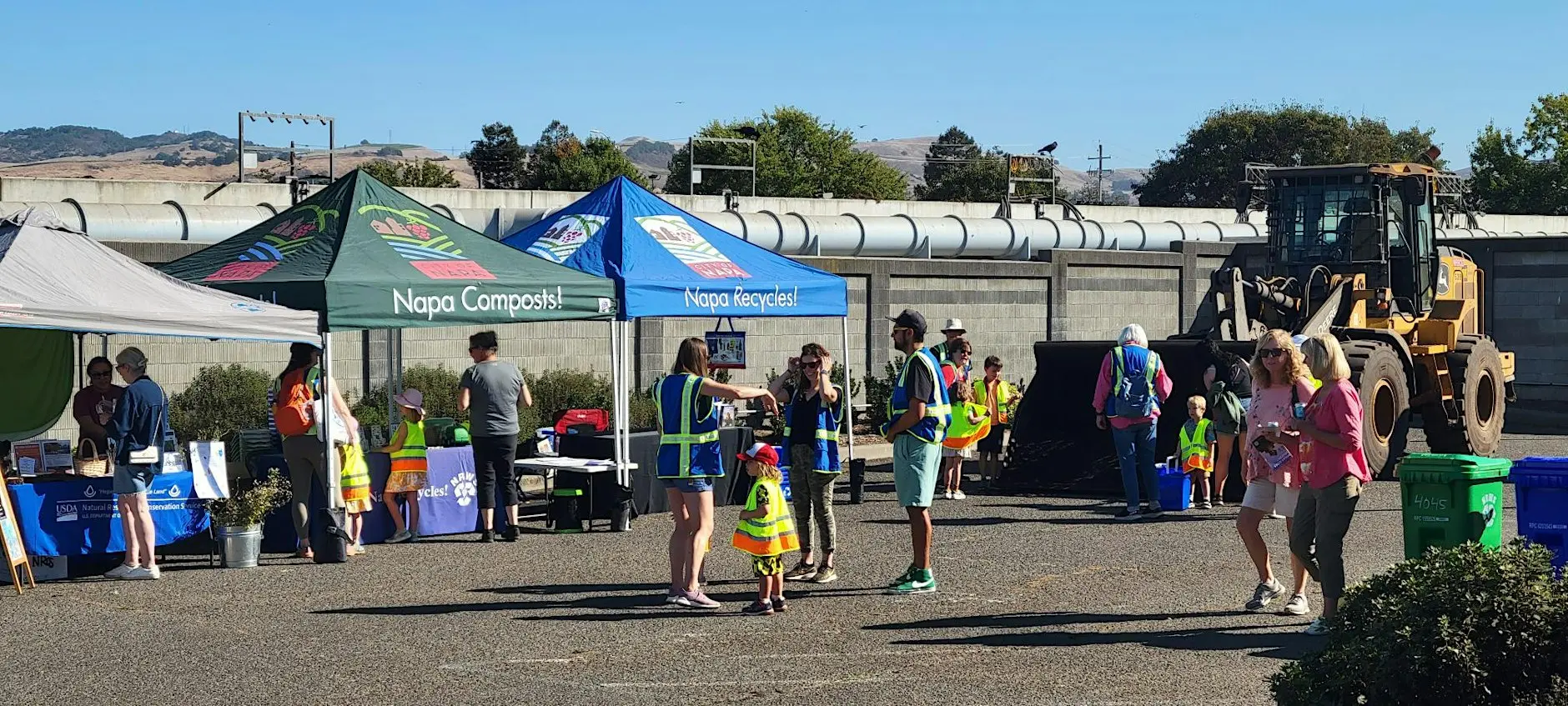
On Saturday, October 10, residents will have a rare opportunity to follow those discards downstream during Beyond the Bin, an open-house tour of the Napa Recycling & Composting Facility at 820 Levitin Way in American Canyon.
Instead of another lecture about being green, the tour connects familiar household habits with what actually happens after the collection truck pulls away.
And if you've ever wondered whether it really matters which cart you choose, the answer is emphatically yes.
Robots, Optical Sorters—and Plenty of Human Help
Material from Napa's blue recycling carts arrives at the facility mixed together. Before any of it can become something new, cans, bottles, cardboard, paper and other materials have to be separated into usable streams.
The sorting operation uses equipment including optical sorters and robots to help identify and recover recyclable materials. Visitors on October 10 will be able to see how that system works.
They'll also see why something as innocent-looking as a plastic grocery bag can create a surprisingly big problem.
Plastic bags and stretchy plastic film don't belong in Napa's blue recycling carts. They can wrap around sorting machinery, causing equipment problems and creating hazards for workers who have to remove them.
Another common mistake is putting recyclables inside plastic bags.
Napa Recycling asks residents to place recyclables loose in the blue cart. Bagged recyclables can end up being treated as garbage rather than recovered.
Food can be another recycling troublemaker. It can contaminate paper and cardboard and interfere with the sorting process.
That's why “when in doubt, recycle it” isn't necessarily good advice. Tossing something into the blue cart because you hope it's recyclable—sometimes called “wishcycling”—can actually make the system work less effectively.
Seeing the process firsthand makes it much easier to understand why a small sorting mistake in your kitchen can create a much larger problem downstream.
Your Leftovers Have a Second Life
Napa's green compost cart has an entirely different destination.
And it can take much more than leaves and lawn clippings.
Food scraps—including meat, bones, dairy products, fruits and vegetables—belong there, along with food-soiled paper such as napkins, paper towels and pizza boxes.
At the facility, those materials are processed using a Covered Aerated Static Pile, or CASP, composting system.
Organic material is blended together and placed in large piles. Air is forced through thousands of holes in the concrete floor while moisture and temperature are carefully controlled. A biofilter layer helps retain heat, capture emissions and control odors.
After roughly three weeks in the actively controlled system, the material enters a curing period. About 40 days later, it is screened and becomes finished compost. And then something rather remarkable has happened.
The banana peels, coffee grounds, pizza boxes and yard trimmings Napa residents put into their green carts can come back into the community as a soil amendment used in vineyards, farms, landscaping and backyard gardens.
The facility even makes finished compost available to the public.
The Wrong Cart Can Cost You
Sorting correctly isn't simply an environmental nicety.
Napa Recycling monitors carts for contamination using inspections, cameras and photographs. If unacceptable material is found, a cart may not be serviced. Customers can be asked to remove the offending material or have the contents collected as landfill waste for an additional fee. That makes knowing which cart to use worthwhile.
Napa Recycling checks carts for contamination using inspections, cameras and photographs. If unacceptable material is found, a cart may not be serviced.
Customers can be asked to remove the offending material or have the contents collected as landfill waste for an additional fee.
That makes knowing which cart to use worthwhile.
Napa Recycling maintains an online Sort Guide where residents can look up individual items and find out whether they belong in recycling, compost or landfill.
It's worth bookmarking for the next time you're standing in the kitchen holding something and thinking, “Where does this go?”
See It for Yourself October 10Beyond the Bin runs from 9 a.m. to 1 p.m. Saturday, October 10, at the Napa Recycling & Composting Facility, 820 Levitin Way in American Canyon.
Guided tours leave every 20 minutes beginning at 9:20 a.m. and continuing through 12:20 p.m. Visitors can tour the recycling operation, see how food scraps become compost and learn about plans to produce biofuel for the collection-truck fleet.
There will also be family tours, a Touch-a-Truck demonstration, community organizations and giveaways.
For families in particular, the tour offers a chance to turn the familiar question of “Which bin does this go in?” into something children—and adults—have actually seen for themselves.
Advance registration is encouraged, and visitors select a tour time when registering.
And bring a bucket.
Visitors can take home free compost made from local food scraps and yard trimmings—a remarkably direct demonstration of what can happen to yesterday's leftovers when we put them in the right cart. |
19 Comments
Join the conversation
Remember to bring a bucket for the compost, that’s a pretty good little bonus after the tour.
I’ve seen plastic film wrapped around equipment at work. Makes sense that it can be dangerous for the people clearing it off.
The biofuel plans for the collection trucks caught my eye. Hope they get that going soon.
I hope they explain what kinds of plastic actually belong in the blue cart. That part is still confusing to me.
Mike H.Me too. The sort guide sounds useful, but seeing examples on the tour should help.
Free compost and a chance to see the facility, that sounds worth the trip to American Canyon.
Angela C.Same here. Taking a bucket for compost makes it even better.
Wishcycling is probably what I do with those confusing plastic containers. I should check the sort guide first.
I’ve always wondered where the carts go after pickup. Seeing the whole process in person would be helpful.
Nina B.It would be interesting to see how much of what we toss actually gets reused.
A tour every 20 minutes sounds pretty easy to fit into a Saturday. Might bring the grandkids to see the trucks.
We use the green cart for food scraps, but I didn’t know meat and bones could go in there too.
The extra fee for a contaminated cart seems a little harsh, especially if people are honestly confused about what goes where.
I’ve been putting recyclables in a bag inside the cart. Glad I saw this, I’ll put them in loose from now on.
Patricia S.Easy mistake to make. I learned the same thing a while back.
Would be interesting to see the robots sorting everything. Might help the kids understand why the bins matter.
The compost part sounds pretty neat. Coffee grounds and pizza boxes coming back as compost for local gardens is a nice idea.
I never knew plastic bags could cause that much trouble in the sorting machines. I’ll stop putting them in the blue cart.
Linda M.Good call. I’ve heard the bags can tangle up the equipment and put workers at risk.